Robotic manipulation · Physically based simulation
TapeSim: Efficient Simulation of Adhesive Tape Dispensing for Robotic Manipulation
1 Carnegie Mellon University2 Genesis AI
A moving roll, a flexible strip, and surfaces that attach and detach.
Overview
Applying adhesive tape to secure wire harnesses or seal packages requires robots to coordinate a flexible strip, a moving roll, and surfaces that attach and detach. Resolving every wound layer is computationally expensive and can suppress roll motion at practical solver tolerances. TapeSim represents most still-wound material as a rigid cluster, while an advancing deformable collar enables progressive dispensing. The released strip remains flexible and can adhere to new surfaces. Releasable bonds simplify the internal adhesive interfaces.
Controlled swing tests evaluate roll motion and computational cost. At 32 turns, clustering gives 3.2–3.4× mean physics-step speedups at a fixed Newton tolerance and 4.5–8.4× for comparable roll motion. Across five real-motion Stick replays, the clustered variants reduce mean image-plane roll-landmark error by 23–29% relative to the fully deformable cohesive baseline. Paired real/simulation policy evaluations cover Peel, Stick, and Wrap, and a teleoperated box-sealing demonstration combines attachment, dispensing, cutting, and sealing.
Method
TapeSim concentrates deformation near the release front and along the free strip. The still-wound interior moves as a rigid cluster, while a short deformable collar advances as tape is dispensed.
Drag the slider to follow the release front. Schematic, not a physical simulation.
Releasable interface bonds
Cohesive contact couples a non-penetration barrier with friction and adhesion. For a selected adhesive interface, a virtual tetrahedron replaces these terms with one shape-preserving bond energy, improving conditioning without adding material or degrees of freedom.
Bonds form between nearby eligible surfaces and release when the opening force exceeds a threshold. Compression alone does not trigger release.
How the four models fit togetherNearby eligible surfaces form a bond.
Schematic loading, not measured force. The illustrated force-based release requires opening; compression alone does not trigger it.
Model configurations
Two interface models, each with a fully deformable or clustered representation.
Bond-R combines releasable internal bonds with the rigid cluster and advancing collar.
Roll motion and computational cost
Resolving every wound layer can make the roll appear nearly frozen at practical solver tolerances. Clustering preserves more of its rotation while reducing the cost of the solve. The video and angle traces below show the same saved simulation states.
Coh-F Coh-RSaved simulation states · detail views: 3× magnification
9.7° → 38.1°Tighter solves restore Coh-F’s rotation without changing the physics.
32 turns · 10−2 → 10−3 m/sIndependent test, not the trajectories above.
Physics-step cost at comparable roll motion
Compare mean physics-step time across four representations and four roll sizes. Select a layer count and interface family below.
Coh-F → Coh-R · 32 turns
At fixed tolerance, the separate 32-turn paper benchmark is 3.4× faster for Coh-F → Coh-R.
32 turns · comparable rotation range · RTX PRO 6000.
Data & comparison protocol +
Mean physics-step times from the comparable-motion experiment. Tolerances are selected by model and roll size to recover the Bond-R target rotation range. Timing excludes front updates, control, telemetry and rendering. This sweep is separate from the motion video and the fixed-tolerance benchmark.
Open-loop replay
Recorded robot commands are replayed in simulation to evaluate agreement with real tape motion. The synchronized comparison below shows a Stick episode; roll-landmark errors summarize five episodes.
Identical recorded commands · common source clock · no marker overlaysSwitch to wipe view to compare aligned images.
Five-episode evaluation
Lower roll-landmark error with clustering
Compared with Coh-F, across five real Stick episodes.
Two repeats per model; active interval t ≥ 3 s.
Each dot is one episode mean; the horizontal mark is the mean across episodes. Hover or focus a point to inspect it.
Tabletop adhesion is calibrated against a measured peel force.
Closed-loop policy evaluation
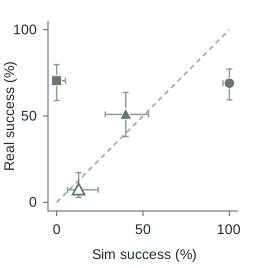
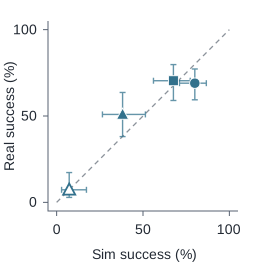
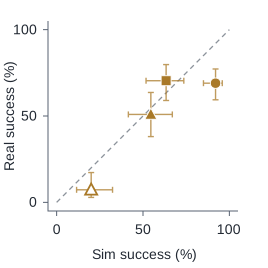
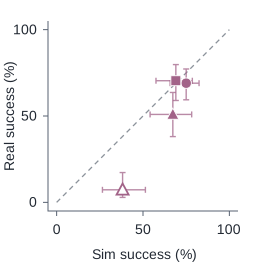
Frozen policies are evaluated in paired real and simulated scenes. Peel tests detachment from the table, Stick tests roll response to free-end motion, and Wrap combines attachment to a new target with progressive dispensing.
Bond-R matches two real turns in this example. The task combines attachment to a target with release from the roll.
55 paired casesExplore aggregate results +
These are full-trial outcomes, not scores for the shortened display clips. Balanced accuracy gives equal weight to real successes and failures.
Swipe the table to compare all metrics →
Real versus simulated success
BibTeX
If you use TapeSim in your research, please cite our paper.
@misc{luo2026tapesim,
  title = {{TAPESIM}: Efficient Simulation of Adhesive Tape Dispensing
           for Robotic Manipulation},
  author = {Zhaofeng Luo and Xinyu Lu and Jaehoon Choi and Zhehuan Chen
            and Trinity Chung and Xiaowen Qiu and Hugh Nicholas Perkins
            and Gianna Calderon and Alexis Duburcq and Sanghyun Son
            and Tsun-Hsuan Wang and Yi-Ling Qiao and Minchen Li},
  year = {2026},
  eprint = {2609.28766},
  archivePrefix = {arXiv},
  primaryClass = {cs.RO},
  url = {https://arxiv.org/abs/2609.28766}
}